Dynamics AX
  RSS Feed  LinkedIn  Twitter
Want to turn you're data into a true asset? Ready to break free from the report factory?
Ready to gain true insights that are action focused for truly data informed decisions?
Want to do all of this across mutliple companies, instances of Dynamics and your other investments?
Hillstar Business Intelligence is the answer then! (www.HillstarBI.com)

Hillstar Business Intelligence for Microsoft Dynamics AX and NAV on Mobile, Desktop, Tablet


Let us prove to you how we can take the complexity out of the schema and truly enable users to answer the needed questions to run your business! Visit Hillstar Business Solutions at: www.HillstarBI.com

Friday, January 18, 2013

My Review of "Microsoft Dynamics AX 2012 Services"


I hope everyone has had a great and productive Dynamics week thus far! I know it's a busy time of year for projects, and changes that a new year brings with it. I wanted to take the time and focus this week on a book I was asked to review. What I'm talking about, is the "Microsoft Dynamics AX 2012 Services" book that was recently released.


This was a book I was ready to see released, and one that I wanted to put to the test. It's a topic that needs understanding by anyone implementing Dynamics AX 2012. What is learned when truly diving into services with Microsoft Dynamics AX 2012 is a foundation for the future.


To help frame the importance of this topic, lets look at an Interview from the past. Doing so will help give meaning to the mention of how services are the foundation for the future of Microsoft Dynamics. Here, you will find my interview with Lachlan Cash from Microsoft.: Microsoft's strategy and vision for Dynamics AX and SOA.

This interview took place in March of 2009, nearly four years ago. However what is laid out in this vision interview is what we see today with Microsoft Dynamics AX 2012 & R2. The vision has become reality, and now it's time to embrace the changes that this foundation of services represents.

From the interview.:
"SOA has been about connecting systems together, we think that it has more a place with-in the application as a fundamental shift in the way business logic is written and designed. This is a long term strategy to make it easier for our customers and partners to adapt the business application to their needs and integrate with other line of business applications." - Lachlan Cash, Microsoft

With this understanding, and a blast from the past, lets look at the amazing job authors Klaas Deforche & Kenny Saelen did with this book. From start to finish it is well thought out, easy to find specific information about topics, and can take a newbie on a journey of services enlightenment.


Starting off, the concepts are covered very well, including basic concepts like "What are services and SOA?". Klass & Kenny advance the reader through a what's new section, and how this section is so important to grasp for those that have been working with Dynamics AX for many years.


All possible service types are covered very well, including the needed understanding for working with Collections, via the infamous AifCollectionTypeAttribute. The reader is throw into great examples that enforce basic concepts, while introducing the 'to-become' services jedi master!

As further proof of Klass & Kenny's understanding what services are in AX 2012, they devoted the entire Chapter 5 to the explain & explore the SysOperation Framework. The following is an excerpt from the that chapter.:
"The SysOperation framework is new in Microsoft Dynamics AX 2012, and is the preferred way of creating batch jobs. It replaces the RunBaseBatch framework, which remains available for backwards compatibility. When Microsoft Dynamics AX 2012 was released, the SysOperation framework was known as the Business Operation Framework or BOF."


Image from book comparing RunBase vs. SysOperation.


The authors also cover well the system services, uses of the system services, and giving full, tested examples throughout the book.

Like any book review, there is always something that can be added. A book, like a house, as any author or architect well knows, is never really finished. It's just a static version, or a version release for consumption and use. With that, there are a few area's that I would like to have seen including in this.

First one, which is near and dear to my heart, is the ODataQueryService. You can find out more about OData and Dynamics AX at the following.: AX-OData Queries.

This, is a very useful system service, that saw much improvements with the release of Dynamics AX 2012 R2. Further this service will continue to become more and more important to fully help complete the vision that was laid out by Lachlan Cash, in the above referenced interview.

Finally, the other area that is the biggest hole in this book is Debugging Services in AX 2012. The referenced link there, covers just the steps needed for getting started, but honestly this is a topic that needs some deep dives, to cover it well and understand the nuances of debugging services for AX 2012.

With this, I give the book a 4.25/5 possible score. Overall this is a really great book, and I would recommend anyone implementing Dynamics AX 2012 to have this as their go to services book.

Well that's it for this week. I plan to get back into the serious side of business insights next week! Check back soon, as more to come. Till Next Time!


Follow Me @:
   RSS Feed  LinkedIn  Twitter

"Visit the Dynamics AX Community Page today!"

Labels: , , , , , , , , , ,

Wednesday, May 25, 2011

Microsoft Dynamics AX 2012 - System Architecture Overview

As we draw closer and closer to the release of Microsoft Dynamics AX 2012, I plan to continue and dive deeper and deeper into all area's of the new release.

With that in mind, lets take a look at what resources we have on Microsoft TechNet.: Microsoft Dynamics AX 2012 - System Architecture


As we can see there is quite a bit of new roles, and also new ways old roles will interact, function, and what they run on.

Starting at the bottom of the diagram, we see that SQL Server of course, plays a major role in a given Microsoft Dynamics AX 2012 solution. To this database point, SQL Server, when AX 2012 is released, will be the only Database Software that Microsoft Dynamics AX will run on. Bye-Bye Oracle option!

You will noticed that we have similar databases here before, like SSRS, SharePoint and SSAS. What's important to understand is that the Dynamics AX database, will take and have both the Transactional Data, as well as the model store for which all Dynamics AX Objects live in.

This is where the AOT moved from the file system, and into the database, and reason why there is a new utility for moving .axmodel files, from one instance of AX into another.

Moving up the stack, we have the AOS and .Net, and within that .Net 4.0 applications, AX Services like the Metadata Service, Query Service and more. Here a lot of changes has taking place, and really openning up Microsoft Dynamics AX 2012, as was laid out in the past post I did some years back with Lachlan Cash.: WCF: The Enterprise Service Bus for Dynamics AX and the rest of the Microsoft Stack

All of these new blocks you see, mixed in, and being hosted by old one's like the AOS, help enable this vision laid out throughout the series of post, including the one mentioned above, that helped describe what the future of AX held. That future is becoming today, with the release of Microsoft Dynamics AX 2012 soon.

There is also a lot more to cover with this, and I recommend taking the time and reviewing each section of the system Architecture. Take a deep dive into the TechNet pages that already exist for Microsoft Dynamics AX 2012.

How we plan installs, how we do modifications, how we extend AX, all is going to change is some degree or another with this release, and it's important to understand the impact of these changes, and how much they enable for a business that will be making use of them.

That's all for now, I will continue this dive next week, with looking into comparing AX 2009 and AX 2012 in this area, and talking about some of the benefits, from this move being made.

Check back soon, as more to come!

"Visit the Dynamics AX Community Page today!"

Labels: , , , , , , , , ,

Thursday, April 21, 2011

Interview with Microsoft's Lachlan Cash on his new role, AX 2012 and more


While at Conv11 I had the chance to sit down with Microsoft's Lachlan Cash. You may recall Lachlan, as he is very active while at Convergence, helping with the keynotes, doing demo's, and also has been on my blog a few times before. (Interview with Microsoft's Lachlan Cash about Dynamics AX Technical Conference)

This time, I sat down with Lachlan to review a lot of different things, including is move from the Microsoft Dynamics AX Product Team, to becoming a AX Solution Architect working with Sri and Hal Howards R&D teams.

The following is the result of that interview.:


Q1: Lachlan, you recently moved from the AX Product team, to Hal Howards Dynamics Research group. Can you tell us a little bit about this new position, and your influence over AX in this new role?

Lachlan: "Making the move from the Product team, to Hal Howards group, and specifically Sri’s Solutions Architect team, put my focus more on the sales process, as well with implementations for Microsoft Dynamics AX.

In this new role, I will focus on helping fill a need that has been identified with helping with sales support questions from a total Solutions Architecture point of view. This includes working with larger implementations of AX, and driving value helping the total solution for a customer scale.

One of the business values, from this new role, and how that influences AX in general will be around creating lessons learned, which in turn help with the partner channel around readiness efforts.

In my new role then, I focus on more of the execution side for helping deliver Microsoft Dynamics AX implementations, through our Partner Channel, and how the functional depth and use of AX fits into the overall total solution package for a given customer.

As part of this, the R&D team can also take what we learn through helping with customers scale and complete their total solution, and if you will – drive backwards through the R&D, and therefore product development to help shape a better and better ERP platform that is Microsoft Dynamics AX."


Q2: Now that Microsoft Dynamics AX 2012 is in public beta, can you talk to the power of things, like the workflow engine & designer, and it’s impact on such ERP project task, like business process modeling?

Lachlan: "The goal with such items, as the workflow engine is to address the need to bridge the gap between development vs. business process modeling. To take and drive true BP workflows, down to the end user level.

With this in mind, Microsoft Dynamics AX 2012 is really the first true step in this direction. We started the foundation for this concept in Microsoft Dynamics AX 2009, but really built upon on it AX 2012. Now that we host the Microsoft .Net Workflow engine, and Visual Studio Workflow designer, the gap between the developer world and business process modeling world has gotten a lot smaller.

Take for example, now with workflow in Microsoft Dynamics AX 2012, you can nest workflows, and have workflow logic that calls upon other workflows. This is truly an empowering step towards a business process modeling world, that leads to a more dynamic and agile ERP platform.

Looking at this from a long term view, the idea would be eventually to drive system configuration away from so much code and parameters, and to more domain specific design, and even language to complete the configuration of a Dynamics AX instance.

The underlying design theme, then is taking and setting up AX, so that this move to decouple modules and sequential code, into more business model concepts then enables in the future the ability to have this ‘lego block’ approach to deploying and even customizing Microsoft Dynamics AX.

Lets look at a real world example, of this decoupling that has already taking a positive affect in Microsoft Dynamics AX 2012. If you look at the new structure and design for the infinite financial dimensions, we have a great story here. In Microsoft Dynamics AX 2009 and before, some code and parameters had to be adjust in order to add a new financial dimension. Now in Microsoft Dynamics AX 2012, no code or parameters are needed. You model your financial dimensions as needed, and the work load is a business user, vs a technical need.

Another great example of this same decoupling, or abstraction that we are doing is the separation of the Inventory dimensions. Before Microsoft Dynamics AX 2012, we had a very tightly created design around inventory dimensions that mixed item attributes along with storage and tracking information. Now we have split these, decoupled them, in a fashion to where the Item Attributes, live abstract from the tracking dimensions, which also both live in an abstract manor, separate from storage dimension.

As we move forward with the development of Microsoft Dynamics AX, more and more of this decoupling will take place, which will help empower and enable customers that choose it as their ERP platform."


Q3: Lachlan, with this new vision, for performing business process modeling via the workflow designer, how much ISV development and also AX 2012 out-of-the-box will be setup using this new approach?

Lachlan: "Microsoft Dynamics AX 2012 represents the first step in this direction. With that, we are still not completely at the point in which true business modeling is mostly done with the workflow designer, and with domain specific components.

For ISV’s, there exists however a new place in which they can deliver their vertical specific expertise through the creation of workflows, and business modeling elements in Microsoft Dynamics AX 2012. In doing so, they would be setting themselves for future releases of Microsoft Dynamics that will use this approach.

For Microsoft Dynamics AX 2012, out-of-the-box business process modeling workflows still reside mostly around the procurement, and procurement templates. However, these are great examples, and a lot more depth than what came out of the box in Microsoft Dynamics AX 2009. From these templates, a customer, or ISV can use, to help them create their own templates that govern other processes.

With regard to the out-of-the-box nature, for business process workflow templates, Microsoft’s focus is and will be around the horizontal needs, which include the five focused industry sectors that will be apart of Microsoft Dynamics AX 2012 and beyond. This means, as I stated earlier, that there is a lot of room for ISV’s to bring their vertical expertise to the table with what now exists in the workflow elements."


Q4: Lachlan, as part of the Microsoft Convergence 2011 keynote, Kiril made the official announcement for Microsoft Dynamics ERP Online. As part of that announcement, it was officially released that Microsoft Dynamics AX version 7 will be built for the cloud first. For the Azure PaaS offering. Care to give a little insight on this?

Lachlan: "When looking at the cloud offering, what Microsoft Dynamics AX version 7, or vNext, will offer is around scale as well as flexibility. The idea that is driven us, is around that enabling flexibility and choice to our customers.

Some customers will want to be 100% cloud based, however what we are seeing mostly is customers that will want to live in a hybrid cloud mode. Where parts of their solution will exists in the cloud, while other parts will still exists on-premise.

The architectural changes you now see in Microsoft Dynamics AX 2012, with the decoupling, unified natural models, abstraction, the move to more .Net all help line up Microsoft Dynamics AX to help offer this eventual true choice for customers.

It is true, that Microsoft Dynamics AX version 7 is being built for the cloud first, however the same code base and offering can still run 100% on-premise, or in a hybrid mode, as well as the partner hosted model that we see geared up now for the Microsoft Dynamics AX cloud story.

The choice is what separates Microsoft Dynamics from the rest of the pack in this regard."


Well I would like to take the time and thank Lachlan for sitting down with me. It's always a pleasure!

As you can see, Microsoft Dynamics AX 2012 represent true generational shift in the ERP landscape. This includes Microsoft Dynamics Cloud ERP offering, and driving to Microsoft Dynamics AX 7, which will be built for the cloud first.

I agree with Lachlan, that, Microsoft Dynamics flexbility and being designed so the customer has a choice in how and what is running in the cloud and not, helps separate it from the rest of the pack! You can read more on my take for Microsoft Dynamics Cloud Vision here: A Guide to Microsft Dynamics Cloud ERP - Dynamics AX

That's all for now, but check back soon as more to come. Till next time!

"Visit the Dynamics AX Community Page today!"

Labels: , , , , , , , , , , , ,

Monday, September 27, 2010

Microsoft Dynamics AX 2011 Technical Conference, session details released!

Recently I did an interview with Microsoft's, Lachlan Cash. (Interview Here)

Well today the Dynamics AX team, including Lachlan himself, has released the details of what all sessions will be going on at the upomcing Microsoft Dynamics AX 2011 Technical Conference.

You can see his write up here.: Session content for the Technical Conference 2011

You can also get directly to the list of sessions here.: Microsoft Dynamics AX 2011 Technical Coference - Session List

This is great news, and I am excited about this Technical Conference. Never before has Microsoft had a sort of PDC event, specifically for Dynamics AX. I think the move shows the amount of Technical changes that will exists with Dynamics AX '6' is released.

Lachlan talked about a few in the interview. With that said, I wanted to list a few sessions I will most likely be attending. This is not a complete list, but a list to start with.:

  • A Domain Modeling Approach to Defining System Functionality and Interactions in AX - In AX6, Dynamics AX engineering teams have begun using Domain Modeling to define the key business entities within the ERP space and the interactions between those entities. This presentation will explain how we are leveraging that modeling to guide our functional coverage planning in test as well how we are using this information to facilitate communication about the functional areas and the interactions between business entities.

    This presentation will provide an overview of the process we have used to collect this information and an overview of the increases in efficiency and completeness that we have seen in our test planning activities. Finally, we will demonstrate how this process can be leveraged by partners to analyze the possible scope of effort required to integrate custom solutions into the standard product.


  • SQL-based Model Store - In Microsoft Dynamics AX the AOD files are replaced with a SQL database. Come and hear about the challenges, the solution and the new opportunities. You will learn the model store schema, and how to write SQL queries against model artifacts.


  • Services and Application Integration Framework Enhancements in Microsoft Dynamics AX - We will provide an overview of the Evolution of Services as a first-class programming model to the Microsoft Dynamics AX system including developer oriented features that make it easy to develop services from X++ business logic and consume externally hosted services.

    Also covered in the session will be an overview of all B2B and A2A integration specific features and the simplified configuration and management of AIF artifacts.


These are just a few that I want to highlight. Looking at the list, I am excited about a lot of sessions actually. There is going to be a lot covered, and I think is most valuable for any customer of partner in the AX ecosystem to attend this.

I recommend taking the time to review the list of sessions, and start planning what you want to attend. This is just not for Technical based consultants either. Functional consultants can really benefit as well.

That's all for now, but check back soon as more to come as we approach AXUG summit, the Decisions Fall 2010 VC, More interviews, examples, and topics!

"Visit the Dynamics AX Community Page today!"

Labels: , , , , ,

Thursday, September 23, 2010

Interview with Microsoft's Lachlan Cash about Dynamics AX Technical Conference

I hope this blog post finds everyone having a good day! This is the start of a series of blog post, where Microsoft's own Lachlan Cash and I talk about the upcoming Microsoft Dynamics AX 2011 Technical conference.

This series of post will be monthly, building up to the Technical Conference, being held start of 2011, at the Redmond campus.


So give a warm welcome to Lachlan, as we kick off this series.:


1. Lachlan, with the upcoming Microsoft Dynamics AX Technical Conference, being held on the Redmond campus in January., can you give us an idea of what people can expect when attending?

"With the new version on its way next year, we looked at what we could do to get partners and customers ready to adopt this latest version. We decided that we would provide broader pre-release access to the product. So that is how the Microsoft Dynamics AX Technical Conference 2011 came about.

That gives you some background to why we are hosting the event. What can attendees expect? We are working on a great lineup of content focused on the next release. There will be over 65 sessions that will completely cover the product. We'll have time set aside to collaborate with the development team in Chalk and Talk and Ask the Experts sessions and also we are teaming up with Microsoft Dynamics AX Certified Trainers to host instructor-led labs.

We are hosting this on the Microsoft campus so that our partners and customers can network with the development team, not only from Microsoft Dynamics AX, but with others that work on the core technologies that AX builds on. We are making sure you get the full picture."


2. For the different sessions, will there be set tracks for say Architects, vs. Developers, vs. Admins, etc? And also will people have the ability to cross track if desired?

"Because this event is pre-release and dedicated to the next release we decided to focus the content for a few key roles what would typically need this information to plan to upgrade solutions. The roles we focused on are architects, developers, IT Infrastructure consultants and functional consultants working with developers on solutions.

We have simplified the deployment footprint of the application so IT consultants will be impressed with less management and expansion of new integrations to the Microsoft Office suite of products. Developers will get to see the innovation in the developer tools and programming experience. More importantly they will get to experience the work that we have been driving in the area of model-driven development. These technology innovations flow across to the application foundation For the functional consultant, there are some important application modeling concepts that we have been working on to help a broader range of customers that are adopting Microsoft Dynamics AX.

In short they will see topics on developer tools, database modeling, application component design, business intelligences tools, office integration around Microsoft SharePoint and the core office products, services integration, IT management, performance, and application lifecycle management.

People can pick and choose what they go and listen to. They don't have to stay in the same track. We know a lot of the people in the channel wear multiple hats so we want to provide great content that can get people inspired.

There is a lot of great innovation to see."


3. Can you pick two sessions, for this first interview, that you can highlight and give a little detail about? Give a sneak peak of sorts?

"Well, we are posting a draft of some of the sessions to the conference Web site soon so that will give you a better perspective of the type of content. But to give you two examples: The sessions on models will be interesting for pretty much everyone. We have simplified how the application is stored, managed, and the approach to storing the application code in the DB has changed and will help simplify the management of an AX implementation.

If you have been working with Microsoft Dynamics AX for a while, then you know we have been working on the implementation of the SSRS reporting engine. SSRS becomes the primary engine in the next release and so developers have some great tools to provide reporting solutions for customers. Likewise customers will benefit from this work because of the integration with Office. So there will be a number of sessions covering not only the SSRS work but across the board from a BI point of view."


4. In regards to the new Microsoft Dynamics AX, what kind of architectural changes will be taking place that you are at liberty to discuss at this time?

"Yes, there are things we want to keep under wraps until the conference. There are two areas of architectural change that you will see. The first is related to the simplification of the IT Architecture and the second to the application and the model-driven architecture.

I'll be a little vague here, :-) but for the IT infrastructure consultant what this means is simplification. Less components to deploy, fewer infrastructures needed to do more, less components to manage. For example, the way we do services integration and where we host the Windows Workflow runtime will change. The AOS is the end point and the workflow runtime is hosted under the AOS. Just less pieces to deploy and manage, which is important for customers small and large because there is just one piece of software to manage."


5. What new development for Microsoft Dynamics AX are you most excited about?

"Yeah, it’s hard one to pin down to just one as there is so much innovation across the board. While this is not a specific feature, I'll have to point to more of a theme across the release, and that’s simplification. The footprint of the functionality is growing because of our industry focus. Even the core horizontal functionally expands significantly. So at the same time as this expansion the software is getting smaller, there are fewer pieces to manage.

Along the same theme for developers, there is simplification in the MorphX development tools and programming as well as choice. If the tool you are familiar with is Visual Studio, and you are building managed code solutions, that is, you develop with the .NET Framework and use C#, VB, or any managed language for that matter, then you will appreciate the work the R&D team have done with evolving the .NET business connector to a new generation of typed managed interop. This time, because we can leverage the work that has been done around models and how we are now storing the Meta data of the application, we can provide access to the business application objects in Visual Studio. Actually we did a small demo of this at WPC2010back in July this year but of course you will see a lot more in-depth at the Technical Conference."


"If I could just finish with saying it will be great to see a lot of familiar faces, as well as new faces at the event in January. We are excited to be able to put this event on, we think it is our little version of PDC for developers or TechEd for the IT folks but just focused on Microsoft Dynamics AX and specifically the next release. We think it's important that our community gets the information early. We are happy that with this version we are providing much earlier access to the product before it is released, something we haven't done before.

So go and register at Dynamics AX Technical Conference 2011. And be sure to check out a sample of the session content that should be published by the time this blog is posted. We plan to have a full catalog by the end of October."


Here a little bit of info on Lachlan, just in case you don't know what is role is at Microsoft at the bigger Dynamics Ecosystem.:

Lachlan is a Senior Product Manager with the Microsoft Dynamics product management team. His current role with Dynamics is to provide programs and tools that support the Dynamics AX channel to work with and demo Microsoft Dynamics AX. He has worked in Microsoft for 8 years across various roles in APAC, EMEA and Corp. He previously worked for Navision and has spent 17 years working with mid-range and enterprise business application software. You’ve probably seen him at Convergence presenting in the keynotes.

I would like to thank the Microsoft Dynamics AX product team, and specifically Lachlan Cash for taking the time to kick this series of blog post off. I hope that you find them interesting, and that it helps give some insight into the Technical Conference and next years release of Microsoft Dynamics AX '6'.

That's all for now, but check back soon as more to come!

"Visit the Dynamics AX Community Page today!"

Labels: , , , , ,

Wednesday, September 22, 2010

A lot of Dynamics Mojo going on

The past few weeks, information about Dynamics License, about Dynamics vs. other ERP platforms, and exciting new developments on vertical offerings, ISV's, and cloud based focuses has been taking place.

Mix this with the upcoming AXUG Summit in Orlando, and also the MSDynamicsWorld.com, Decisions Fall 2010, Virtaul Conference, as well with the offical Microsoft Dynamics AX 2011 Technical conference coming in Jan., what do you get?

A lot of Dynamics Mojo going on!


Interest level in Dynamics AX has never been higher, with searches continued to increase around not just core Dynamics AX information, but also vertical solutions like PDM / PLM, Cloud, and more.

So to help centralize and bring the mojo together in one place, the following is a list of good information that I think everyone needs to review.:


So, as I said, I am calling this the Dynamics Mojo, and for good reason. With all the interest, information, portals, groups, conferences, and more. There is plenty of places and ways for a company to help decide if Dynamics ERP is the right choice for them. There is also plenty for customers who have already made that right choice, to have access too, to help extend their Dynamics investment.

It's a very exciting time that we are in, and the excitment will only continue as we close out 2010 with a bang, and kick off 2011 with even more Dynamics Mojo!

I have a special treat starting soon, that will be a series of post with Microsoft's own Lachlan Cash, focused around Dynamics AX '6' and the Dynamics AX Technical Conference 2011. Also expect coverage of the AXUG Summit and Decisions Fall VC on this blog, plus much much more!

"Visit the Dynamics AX Community Page today!"

Labels: , , , , , , , , , ,

Tuesday, May 12, 2009

Whitepaper: Consuming Web Services in Microsoft Dynamics AX 2009

The following link is a Whitepaper from Microsoft, on consuming web services in Dynamics AX 2009: Consuming Web Services in Microsoft Dynamics AX 2009 White Paper

This whitepaper was published just a few days ago, 5/5/2009. This white paper covers the basics of working with the AOT objects, creating a service reference from within the AOT, and creating the class and correct X++ syntax usage for making use of the new service reference.

Web Services, and WCF Serverices are becoming more and more the way to integrate. In fact they should be the way most things are integrated these days, espically new integrations into Dynamics AX 2009 and beyond.

Just check out this post I did, when I talked to Lachlan Cash from Microsoft. You will see SOA and WCF Services will be of heavy focus in the next release of AX, and can already be made use of today in Dynamics AX 2009.:

- Microsoft's strategy and vision for Dynamics AX and SOA
- WCF: The Enterprise Service Bus for Dynamics AX and the rest of the Microsoft Stack

This white paper is a simple, step by step guide for pratical use of Web Services inside Dynamics AX 2009, for working with them and consuming them. It is a must for all developers, technical consultants to understand this now and moving forward.

Check back soon, as more great post are coming your way! See you then!


"Visit the Dynamics AX Community Page today!"


Labels: , , , , , ,

Tuesday, March 10, 2009

WCF: The Enterprise Service Bus for Dynamics AX and the rest of the Microsoft Stack

Recently I did an interview with Microsoft's Lachlan Cash. The interview can be viewed here: Microsoft's strategy and vision for Dynamics AX and SOA

In that interview, Lachlan laid out the vision for what role Microsoft see's SOA playing in the current and future of Dynamics AX.

If you read the interview, you will see that the underlying goal and drive is that SOA, or Service-oriented architecture, will be the design principle for inside and outside development of Dynamics AX. This will be delivered by WCF or Windows Communication Foundation, and can have Windows Workflow Framework be used as well as part of the business process design flows that this stragey enables.

So that means that we should focus are energy and attention for the current version of Dynamics AX integration to be geared around WCF adapters. The reason this is the case, is that this will become even more importantly the focus in Dynamics AX 6.0 that is currently scheduled to be released in 2011.

So with that said, lets start to get our minds wrapped around WCF. The best place to start, if you have not already been, is go to the WCF home on MSDN: MSDN - Windows Communication Foundation - Home Page

A great description of what WCF is, can be found here:
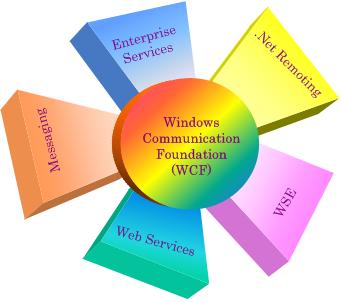
"The WCF unifies the various communications programming models supported in .NET 2.0, into a single model. Released in November 2005, .NET 2.0 provided separate APIs for SOAP-based communications for maximum interoperabilllity (Web Services), binary-optimized communications between applications running on Windows machines (.NET Remoting), transactional communications (Distributed Transactions), and asynchronous communications (Message Queues). WCF unifies the capabilities from these mechanisms into a single, common, general service-oriented programming model for communications.

WCF can use SOAP messages between two processes, thereby making WCF-based applications interoperable with any other process that communicates via SOAP messages. When a WCF process communicates with a non–WCF process, XML-based encoding is used for the SOAP messages but when it communicates with another WCF process, the SOAP messages can be encoded in an optimized binary format. Both encodings conform to the data structure of the SOAP format, called Infoset.

WCF uses a pluggable encoding system, allowing developers to write their own encoders[1]. With the release of the .NET Framework 3.5 in November 2007, Microsoft released an encoder that added support for the JSON serialization format to WCF[2]. This allows WCF service endpoints to service requests from AJAX-powered web pages."


That was taken from the Wiki home page for the Windows Communication Foundation home on wikipedia.org, found here: Wikipedia - Windows Communication Foundation - Home Page

You see when we reference WCF in terms of something that we want to create and make use of, then we are talking about a WCF Service. A WCF Service, as you can read in the wikipedia article, is made up of three parts:


  • Service Class

  • Host Environment

  • Endpoints (aka: Adapters)


So when thinking in terms of today with Dynamics AX 2009, and WCF Service can be defined in the AOT now, and X++ can reference it like a class. This should also be the diffection used for most integrations with AIF, and integrations to and from Dynamcis AX 2009.


(Image Source www.codeproject.com)


This means that when we moved to Dynamics AX 2009, we were a lot closer to having a tighter integration between Dynamics AX 2009 and the rest of the Microsoft stack.

Now there is still a ways to go of course, and since Microsoft is about evolving this, building upon WCF Services now inside and out of your Dynamics AX 2009 instance, means you will be making the right move for the future when Dynamics AX 6.0 & 7.0 comes out.

Because WCF will be moving more and more "into" Dynamics AX and X++, to where WCF could be more tighly used within Dynamics AX itself to delivery internal messaging. This would lead to tighter integration and better introp even more with the rest of the Microsoft stack, which will happen to be also using WCF service to connect and build with.

I think the picture is pretty clear now, WCF should be the focus, and we should start looking into more and more ways of using WCF now and how we will be able to use it in the future.

Some of the latest things out about WCF recently is with REST, Representational State Transfer, which will gives us play into the 2.0 tagged technologies of Enterprise and Web, and the cloud.

Another thing to point out, is how WCF can now, already be used to integrate other existing LOB, Line of Business Applications, like: SAP, PeopleSoft, Oracle, IBM CICS, IMS, etc.

Microsoft released what is calls it's "WCF LOB Adapter SDK" to help with this. The current version is 1.1, and can be downloaded here: WCF LOB Adapter SDK v1.1 Download.

So we have a *Lot* to cover on this as you can tell. The key to take away now, is to start looking into this. Take a dive into the MSDN page, look at the blogs, the articles, what makes up WCF. Also take the time and check out the WCF LOB Adatper SDK. This is a great thing to look at for creating WCF services, that can connect Dynamics AX with other LOB's.

Check back soon, as I will continue to dive into this topic, get back to some SQL Server 2008, cover more BI, and all how it surronds and is used with Dynamics AX.

Also don't miss my post soon on a book review and Author interview I am doing, and the wrap up post on Convergence this week! So much to cover and so little time... see you next time!


"Visit the Dynamics AX Community Page today!"


Labels: , , , , , , , , , ,

Thursday, March 05, 2009

Microsoft's strategy and vision for Dynamics AX and SOA


I recently had the pleasure of taking the time and talk with Microsoft Senior Product Manager for Microsoft Dynamics AX, Lachlan Cash.

The focus of this interview was driven actually by the recent Microsoft SOA & Business Process Conference held recently. One of the sessions was on 'Dynamics AX & SOA' presented by Leslie Sistla of Microsoft.

I contacted Leslie about this presentation and she was kind enough to get Lachlan and myself together to discuss Dynamics AX, SOA and Microsoft strategy and vision for these topic area's.

Here is the result of that interview:

Brandon - Recently Microsoft hosted their SOA conference, and one of the topics was Dynamics AX and SOA. The session covered a good bit of technologies, and goals. If you could sum up though, in a paragraph or two, what would be the core message that you were trying to get across with this recent session?

LC - "I think the key things that we think about in Dynamics when we talk about SOA is ease of integration and customization of the business application. To this point SOA has been about connecting systems together, we think that it has more a place with-in the application as a fundamental shift in the way business logic is written and designed. This is a long term strategy to make it easier for our customers and partners to adapt the business application to their needs and integrate with other line of business applications. Today we have a very good customization story around AX, and we think we can make it a lot better with adding SOA."

Brandon - Recently Microsoft has started a new trend with ‘____ for the masses’ tags for describing goals and approaches for technologies and platforms. For example the move for taking PerformancePoint and making it part of the SharePoint offerings, was tagged as a move to start a ‘BI for the masses’ approach. Is Microsoft also trying to offer ‘SOA integration for the masses’ or ‘BPM for the masses’ with their approach to Dynamics AX and SOA?

LC - "We have to look at the roles and people that work with a business application and work on implementing it for customers. SOA today isn’t for the masses. Do business users benefit? Yes, if it helps bring new features and new functionality to the application they use. SOA is for developers and will be for developers. So SOA brings new ways to build and integrate systems with Dynamics AX. This in-turn brings new capabilities for business users."

Brandon - With SOA, so many different technologies are used. In Dynamics AX alone, you can choose many paths to achieve such offers. Custom web services and .Net assemblies with X++. AIF, BizTalk, etc. With so many paths to take, and so many different possibilities of connecting technologies and platforms, can you provide us with insight into the desired directions or paths and clear choices of when and why for those different paths?

LC - "Our strategy with AX is simple, we are following Microsoft’s overall strategy with the .NET Framework. This includes Windows Communication Framework (WCF) and Windows Workflow Foundation (WWF). In AX 3.0 we had the Commerce Gateway which provided a integration to BizTalk and provided some basic functionality. We started in AX 4.0 to build a better integration framework and introduced an adapter for BizTalk. Then AIF evolved more in AX 2009 to be a generic integration piece of technology for working with WCF based services. This lessens the needs for a specific BizTalk adapter as we can adapt adapters that are in WCF and use WCF as the Enterprise Services Bus to move data between systems that have WCF adapters like BizTalk. We will continue to evolve the AIF as we go into AX 6.0 to unify integration around the .NET Framework, and the rest of the Microsoft stack. "

Brandon - With doing architectural design of Solutions that span platforms and technologies, with Dynamics AX at the heart of such designs. What types of layout considerations and investmest can customer make in current technology and platform offerings from Microsoft that will enable solutions today, that will also give them a clear path and correct stepping stone for the road map of the future?

LC - "The overall goal of Microsoft is to make sure and be driven by the ecosystem that surronds Dynamics. We have had the ability to watch other companies, take and make major changes in the technical nature of how things are addressed and developed. In doing so we have seen how hard it has been for the customers of these other companies that are now on their legacy systems to upgrade. It's a huge jump.

Instead Microsoft focuses on making sure the changes we make evolve rather than be major changes which can cause an upgrade to be a major decision for an existing customer.

Investing in Dynamics AX, .Net, WCF, WFF, BizTalk and the rest of the Microsoft stack today, means that in the next releases there will be clear paths for upgrading. So building solutions today with Microsoft's current offerings will be the right direction for making an investment for the future."


Brandon - You have mentioned a lot of the technologies that surrond Dynamics AX and make up the Microsoft stack. Since this is the case, and your point about evolving is the focus. What about the .Net business connector / External Connector used to connect .Net managed code to an AOS. It's not managed code right now, and it's lacking in some respects. What or when will this change to offer a more direct, native interaction from say a custom .Net assembly?

LC - "As stated in the previous question and answer, Microsoft's strategy is to evolve. We don't want to make a total change and cause a bottle neck in the upgrade process.

Instead our focus for AX 6.0 is developing new tools, and technologies that allow for better managed interop for Dynamics AX and the External Connector. That will be the focus for this area. Offering better interop between Dynamics AX and .Net, with focusing on WCF as the service bus that facilitates these integrations."


Brandon - Looking at this from the other direction, in what version of Dynamics AX will X++ become a managed language? When will it become a .Net framework language?

LC - "There have been a good bit of prototypes around making X++ a .Net language. In making it a managed language. What we have to look at is what would be gained from such a port?

Microsoft is the biggest user base of X++, with a very large amount of developers working with it. The focus is more on how to improve the interop between X++ and calling to the outside world.

Because this is the case, and so much business logic is tied into X++, it will most likely not ever get ported to become a managed language. It will also not ever be going away, and it will stay as the language used to develop for Dynamics AX.

The whole focus coming out over the next releases will be SOA, via WCF services. That is the key, and doing that will enable better interop, and offer more flexibility and offer more ability to developers and ISV to interact with the rest of the Microsoft stack and custom .Net applications."


This is some great information, and a lot for all of us to dig into. This information will also be talked about and covered at this years Convergence in New Orleans. Lachlan Cash will be there attending a lot of the sessions and also doing demo's in some of the keynote speeches that will focus on some of the technology directions and advancements for Dynamics AX. I recommend, if you have the chance, to stop and talk with Lachlan. Make sure to tell him I sent you! (Convergence 2009 Web site)

Also check out the a demo that was done by Lacklan at the EMEA Convergence this year: Line of Business Demo - EMEA Convergence 2009

Check back soon as I continue further into this Dynamics World. Also this summer I will be re-visiting Lachlan to pick his brain about Dynamics AX 6.0 release and some of the features that were talked about in the above.

I want to thank Lachlan and Leslie for taking the time and talking with me. This conversatin really has my mind thinking about all kinds of things. See you next time!

The link to Microsoft's page on the SOA conference can be found here:
Microsoft SOA & Business Process - Conference Page

A direct link to the PowerPoint that was used for the Dynamics AX & SOA session presented by Leslie Sistla can be found here:
Dynamics AX & SOA - Session PowerPoint File.


"Visit the Dynamics AX Community Page today!"


Labels: , , , , , , , , , , , ,


Copyright 2005-2011, J. Brandon George - All rights Reserved